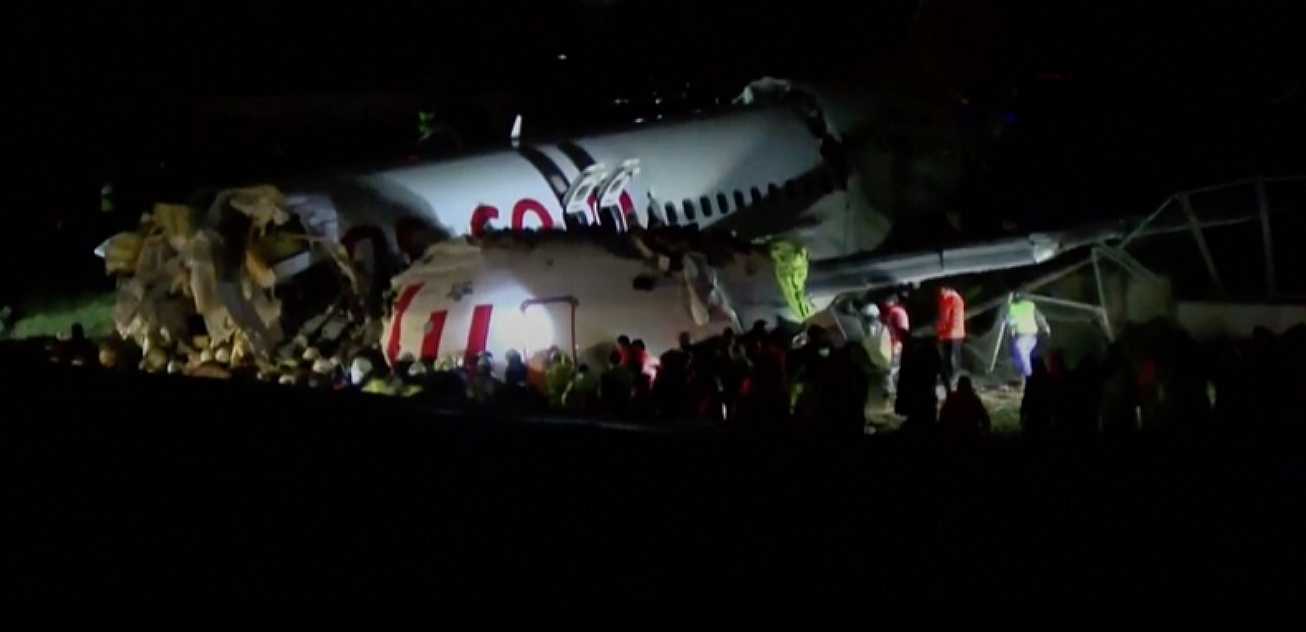
«Our pain is great». In a press release issued on Thursday morning, Pegasus Airlines confirmed that three passengers died in the crash of flight PC2193 on Wednesday (February, 5). The Turkish low-cost airline's Boeing 737 had overshot the runway at Istanbul-Sabiha Gökçen Airport the previous evening, slipped down a slope and broke into three pieces. What is known about the accident so far?
The flight: Flight PC2193 took off from Izmir on Wednesday with a delay of 43 minutes. During the landing in Istanbul a thunderstorm hit the region. Winds from the southwest swept over the airport at speeds of 40 to 65 kilometers per hour.
The accident: During the landing on runway 06 at Sabiha Gökçen Airport at 6:19 pm local time, the Boeing 737 of Pegasus Airlines experienced a lot of tailwind. Surviving passengers reported that the aircraft had been shaking on approach, and continued to shake after landing. According to the Aviation Herald, which specializes in incidents, it touched down only about 1000 meters before the end of the runway or 1950 meters after the threshold. It overshot the runway and then fell down an embankment. One engine caught fire and the fuselage broke in three pieces. The accident site is about 20 meters below the runway.
The route: PC2193 is operated daily by Pegasus and takes passengers from Adnan Menderes Airport in Izmir to Sabiha Gökçen Airport in Istanbul. Boeing 737, Airbus A320 Neo and sometimes A320 are on the route. The journey takes between 45 and 50 minutes.
The aircraft: The crashed Boeing 737-800 carried the registration TC-IZK. It was eleven years old and was owned by the Irish-Japanese leasing company SMBC Aviation Capital. Pegasus was the second operator of the jet. It was in service with Air Berlin from 2009 to 2016.
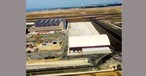
The airport: Istanbul-Sabiha Gökçen is located on the Asian side of Istanbul. The airport is the hub of Pegasus Airlines. It has a concrete surface runway 06/24 with a length of 3000 metres and a width of 45 metres. At the end of runway 06 there is a 65-metre-long stopping area, behind which there are antennas and a wall, followed by a slope.
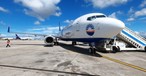
The airline: Pegasus Airlines is a private Turkish budget carrier. It was originally founded in 1991 as a charter airline with the help of Aer Lingus. Since 2005, it has been operating as a low-cost carrier. Its fleet now comprises 83 aircraft, including Boeing 737-800s, Airbus A320s, A320 Neos and A321 Neos. Pegasus is one of the ten largest airlines in Europe in terms of passengers carried.
The accident statistics: The airline recorded a similar landing accident in Trabzon in 2018. At that time, a Boeing 737 also veered off the runway. It then slid down a slope into the sea. No one was injured in the accident. Official investigation results are still not available. After the accident a pilot said that one of the engines suddenly developed thrust. To date, there have been no injuries or fatalities in incidents involving Pegasus Airlines aircraft.
The crew: On board the Boeing 737 were two pilots and four flight attendants. Further information is not yet known.
The passengers: There are different details on this. While the Turkish Minister of Health spoke of 171 passengers, the Governor of Istanbul named 177 passengers, 175 adults and two babies.
The victims: There are contradictory figures here too. According to the Turkish Ministry of Health, 179 people were injured in the accident. There were three fatalities - all of them passengers.
What we know about the crash landing in Istanbul so far