One thing Dhondup Gyaltshen doesn't let stand. «People always talk about Paro being a dangerous airport. It's not dangerous,» says the chief pilot of state-owned airline Drukair. «But operating there is a challenge.»
Paro International Airport is Bhutan's national airport and is located in the valley of the Paro Chhu River at 2235 meters above sea level. All around, mountains rise to 5500 meters. Because of the high altitude, planes cannot take off and land here with full loads. «The density of the air decreases as the altitude increases,» explains the experienced pilot.
The best place for the airport in Bhutan
This problem is exacerbated when temperatures rise in the summer. Currently, the temperature is 33 degrees, he said. «At high altitude and high temperatures, the air then becomes very thin,» says the pilot. But that and the location in the narrow valley are not the only challenges Gyaltshen and his 23 colleagues face every day.
Then there is the runway, which is quite short at 2265 meters and can hardly be extended because of the topography, and the weather. «If you list all the points like that, we actually have negative aspects that would speak against building an airport.» Still, it is the best place for an airport, the experienced pilot said. «From Paro International Airport, you can reach the capital Thimphu in an hour's drive.»
Very strong winds in spring
The weather at Paro Airport is especially challenging in the summer, he said. «During the monsoon, the weather can change every 15 to 20 minutes,» said Drukair's chief pilot. Spring is also difficult, he said. «Then we have very strong winds,» Gyaltshen said. «But we've gotten used to it well.»
Bhutan's only international airport knows no technical aids. There is no instrument landing system ILS. «We always approach on sight,» Gyaltshen explains. His airline has three Airbus A319-100s, an A320 Neo and an ATR 42.
Mostly landing from the south
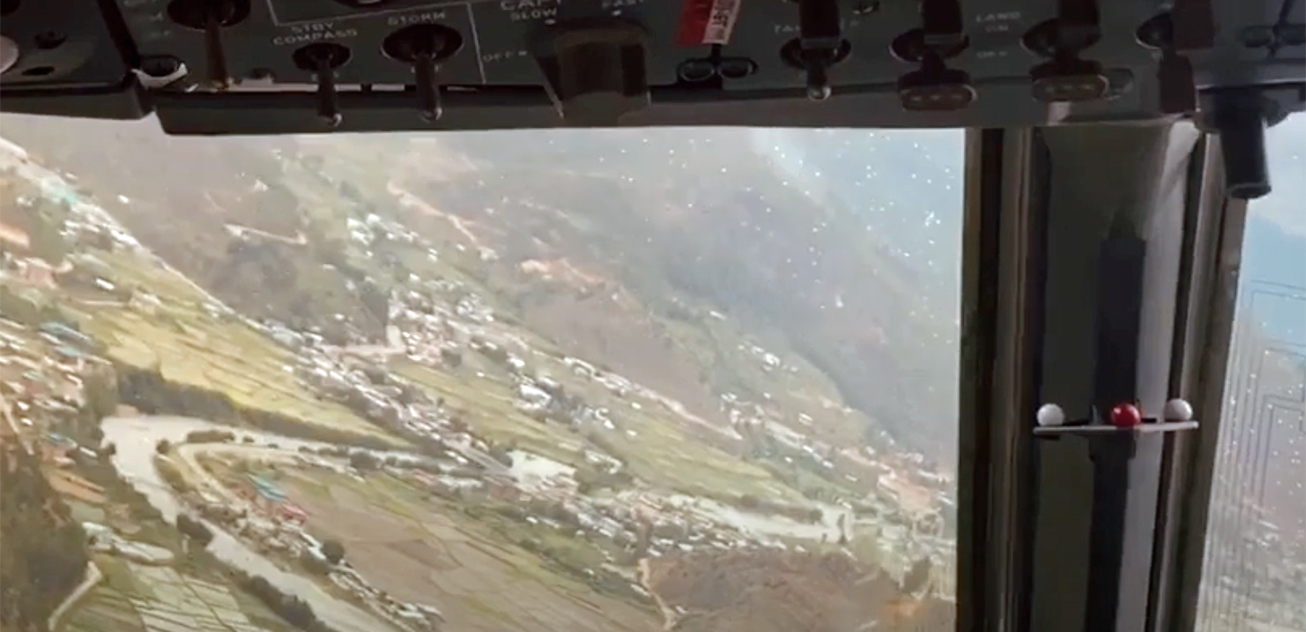
Most of the time, Drukair pilots land on Runway 33 from the south. «There is a waypoint south of the airport called Takti, where we descend to 16,000 feet, or 4876 meters,» explains the chief pilot of Bhutan's national airline. When you see the beacon south of the airport, he says, you descend to 13,500 feet and then to 12,000 feet. «That's where we have to see the runway or we can't land,» he says.

aeroTELEGRAPH
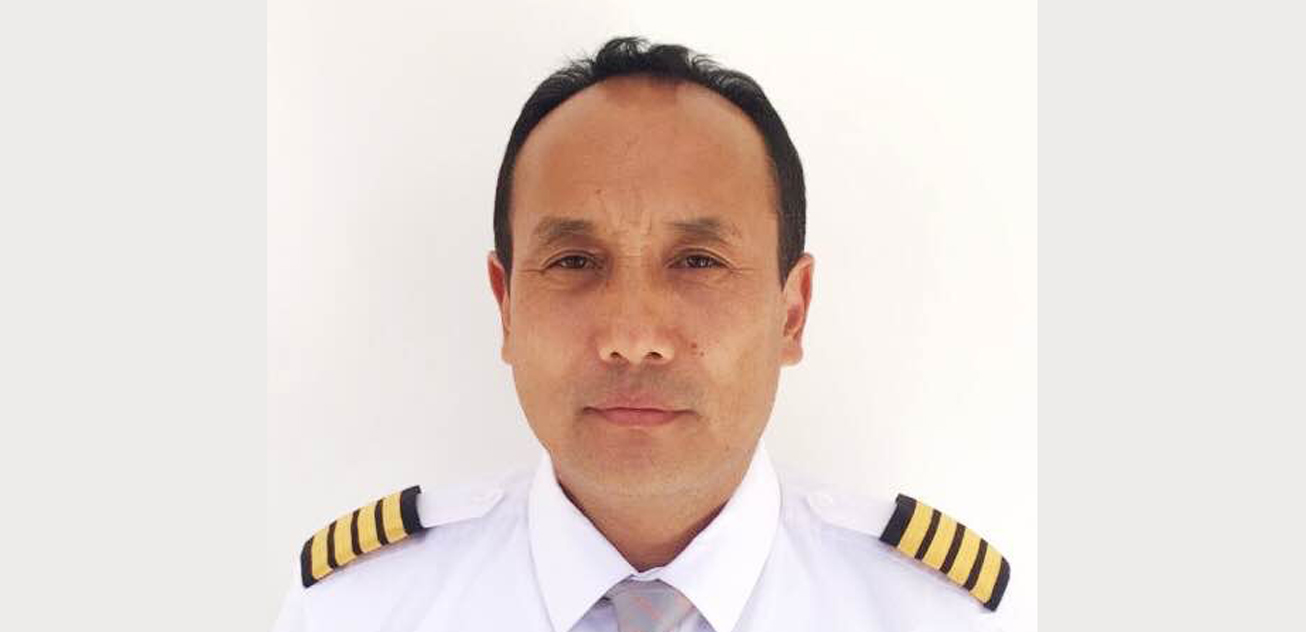
Dhondup Gyaltshen. Source: Drukair
«When we see the runway, we orient ourselves to landmarks,» Gyaltshen says. Now a turn is coming up. At about 10,000 feet, the cockpit crew catches sight of a temple. «There are two to three minutes left before touchdown.» At the last minute, another sharp turn is flown to align the aircraft with the runway.
All on sight
To be allowed to land at Paro International Airport, pilots must undergo intensive training. First comes training in the simulator. «We do three or four sessions where we practice approaches to both runways, engine failures on takeoff and turning,» says chief pilot Gyaltshen. After that, the rookies must complete 40 flights with a training captain.
Anyone who flies in Bhutan must really love flying, says the experienced captain. «Today, everything is automated everywhere, you have GPS, you have ILS. Of course, there are many small airports in the world, but for smaller aircraft. But for the size of our Airbus jets, Paro is one of the biggest challenges because we fly purely manually and visually,» Gyaltshen says. On approach, cockpit personnel even have to turn off the Ground Proximity Warning System GPWS, which warns of collisions with terrain. «It would constantly strike.»
Two alternate airports
To land in Bhutan, Drukair's Airbus A319s still had to be specially modified to land in Paro. «The normal engine used by other operators cannot provide enough power,» Gyaltshen said. The Himalayan kingdom's national carrier relies on CFM-56-5B engines with a thrust of 120 kilonewtons. The Airbus A320 Neo, on the other hand, is identical in design to the aircraft used by other airlines. Its engines are powerful enough.
And what if a landing is not possible? «We have two alternate airports in India,» Gyaltshen says. The closest is Bagdogra and is about 15 minutes from Paro; the other is Guwahati and is about 25 minutes away.
Still overwhelmed
But does the pilot still enjoy the fascinating scenery, or is he too busy? «Every time, really every time. I've been flying for over 33 years, and every time I arrive at the airport, I'm very, very satisfied,» Gyaltshen says.
This is how you land an Airbus jet at Bhutan's main airport