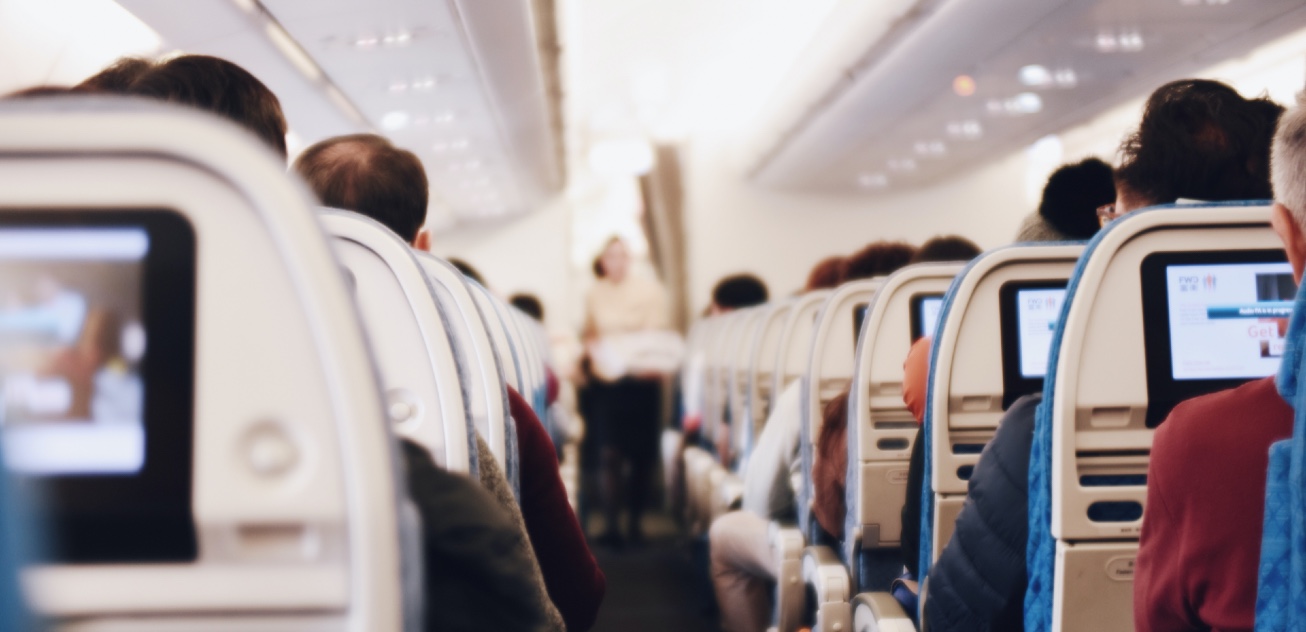
Anyone who travels a lot by plane has certainly experienced it a few times: Shortly after returning home, you have a cold, a stomach bug, or the flu. And where else would the infection have occurred if not on the plane? After all, you were sitting in a very confined space with hundreds of other people.
But in fact, it is quite unlikely to get infected in an airplane - at least if you follow some rules. Because: The air in aircraft cabins is comparatively clean. Almost all passenger planes have so-called suspended matter filters or hepa filters (the letters stand for high efficiency particulate absorption). They filter 99.97 percent of all hazardous particles from the cabin.
Droplets do not travel that far
Every three minutes all the air in the aircraft is completely changed. According to the International Air Transport Association Iata, it is therefore comparable to that in the operating theatre of a hospital. In addition, the air flow goes from the ceiling to the floor. This means that the droplets through which viruses are transmitted do not fly as far as in rooms without such air circulation.
According to Iata, the current pandemic has also shown that infection rates on board airplanes are very low. A survey of 18 major airlines has not revealed a single transmission from passenger to passenger, only from passengers to crew members and between pilots.
No infection from passenger to passenger
In a more detailed study, the association carried out a survey among 1100 passengers who tested positive for the new coronavirus after a flight. No infection was found in the approximately 100,000 passengers who traveled with the affected persons. Only two crew members were infected, according to Iata. The investigation was conducted between January and March, when air traffic had not yet come to a standstill.
The fact that only the crews are affected by the infections also shows where in the aircraft the greatest danger of infection lies: In direct contact with infected persons. The mandatory wearing of face masks can therefore protect against transmission.
One can also come into contact with viruses and bacteria via surfaces. Because there the pathogens can survive for a while. Many airlines have therefore now adapted their cleaning routines and disinfect their cabins as standard after every flight.