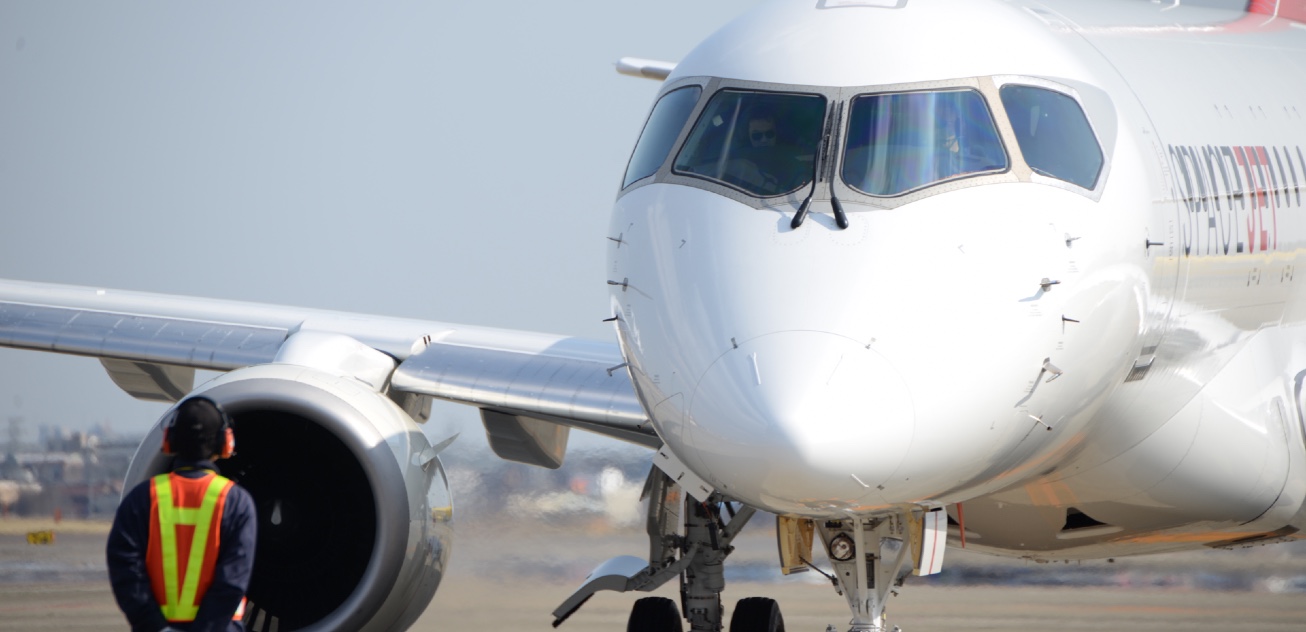
Mitsubishi Spacejet M90: Vorerst die einzige Variante.

Spacejet M100Mitsubishi puts project for smaller Spacejet on hold

After large losses, parent company Mitsubishi is hitting the brakes. It cuts the budget for the Spacejet project in half. Development of the smaller M100 version is halted for the time being.

Top-Jobs

Sparfell Logo

CAMO Engineer f/m/d (full time) in Vienna (Austria)

Vienna
Feste Anstellung
Business Aviation
SPARFELL Luftfahrt GmbH
Österreich
Vollzeit
Top jobs
DERTOUR Logo

Reiseleiter (m/w/d)

Reiseveranstalter
DERTOUR Destination Services AG
Griechenland
Spanien
Portugal
Top jobs
logo aerotelegraph rund

Journalist:in Militärluftfahrt und Verteidigung

Medien
aeroTELEGRAPH
Top jobs
Home Office
Lübeck

Safety Manager (m/w/d) am Flughafen Lübeck

Lübeck
Feste Anstellung
Flughafen Lübeck
Deutschland
Vollzeit
Top jobs

Financial year 2019/20 was not a good one for Mitsubishi Heayy Industries. The Japanese industrial giant fell deep into the red. It is its first loss in 20 years. The loss amounted to 312 billion yen or the equivalent of 2.7 billion euros.

A prestige project is to blame for the bad result. Mitsubishi Heayy Industries made a loss of 263 billion yen, or the equivalent of 2.3 billion euros, with the regional aircraft Spacejet in the financial year that ended in March. The worst thing about it is that in view of the corona crisis and airline savings programs, the outlook for the coming years is no better.

«Proceed at an appropriate rate»

This is why Mitsubishi Heayy Industries is now hitting the brakes. The group is cutting the budget of its subsidiary Mitsubishi Aircraft for the current financial year 2020/21 in half to 60 billion yen or 520 million euros. It will continue a detailed review of the Spacejet timetable «in view of the difficult market conditions facing commercial aviation and the setbacks in flight tests», according to the presentation of the annual results.

At a press conference, Group CEO Seiji Izumisawa became more specific: «We will continue with the project on an appropriate scale, taking into account the difficult circumstances facing our group», he said according to the Japan Times newspaper. So far, the first delivery of a space jet was planned for early 2021 - which already represents a delay of eight years.

Product for the regional market in the USA

That's not all. Mitsubishi also puts the development of the smaller Spacejet version M100 on hold. It was formerly called MRJ70 and is explicitly aimed at the regional market in the USA. But the Japanese expect little momentum from there in the coming years. However, the 34.5 meter long version, which can carry a maximum of 88 passengers, will not be abandoned. The project is constantly being reviewed, Mitsubishi said.

The first version is the Spacejet M90, formerly MRJ90. It will be 35.8 metres long and can carry up to 92 passengers.

Mehr zum Thema

Flieger von Condor: Die Airline kann weiterfliegen.

«We are seeking a new investor»

Airbus A320 Neo von Vietnam Airlines: Die Fluglinie muss Kredite erst später zurückzahlen.

Regierung greift Vietnam Airlines unter die Arme

Militärparade vor dem Flughafen von Mexiko City: Künftig wird der Flughafen vom Militär betrieben.

In diesen zehn Ländern geht es mit dem Luftverkehr am steilsten bergauf

Boeing 747 von Western Global: Der Airline geht offenbar das Geld aus.

Amerikanische Frachtairline kämpft ums Überleben

Video

alaska airlines
Die amerikanische Fluggesellschaft ist Boeing-Kundin durch und durch. Das zeigte sie bisher auch auf jedem ihrer Flugzeuge - mit der Aufschrift Proudly All Boeing. Nun hat Alaska Airlines ihren Slogan angepasst.
Benjamin Recklies
Benjamin Recklies
alaska airlines 1282 ntsb boeing 737 max 9
Obwohl im Flug ein Loch im Rumpf einer Boeing 737 Max 9 von Alaska Airlines klaffte, landete die Crew das Flugzeug im Januar 2024 sicher. Jetzt klagt der Kapitän gegen den Flugzeughersteller.
Timo Nowack
Timo Nowack
amsterdam schiphol schneemann
Der Schnee sorgt für Chaos und Hunderte Flugausfälle am größten Flughafen der Niederlande. Trotz der harten Bedingungen hat das Bodenpersonal in Amsterdam offenbar Spaß bei der Arbeit.
Timo Nowack
Timo Nowack